
Outdoor lighting on the Gold Coast isn't just security or wayfinding — done well, it transforms a garden into a different space at night. The same patio that looks ordinary at 5pm becomes architectural and intimate at 7. The same pool surround that's a daytime feature becomes the centrepiece of every dinner.
But the Coast climate punishes lazy lighting. Salt corrodes fittings, UV breaks down poor-quality cable insulation, humidity gets into connection points. This guide covers what works on the Coast specifically — fixture types, materials, design principles, and what it actually costs.
The four types of outdoor lighting on a Coast property
1. Path lighting
Functional and aesthetic. Marks paths, defines edges, makes the garden navigable at night. Coast standard: 12V LED bollards or mushroom-shaped path lights at 3-4 metre spacing along walkways. Marine-grade brass body, warm 2700K light, IP65 minimum waterproof rating.
- Cost installed: $200-$400 per fixture.
- Power: 1.5-3W LED per fixture.
2. Feature lighting (uplights)
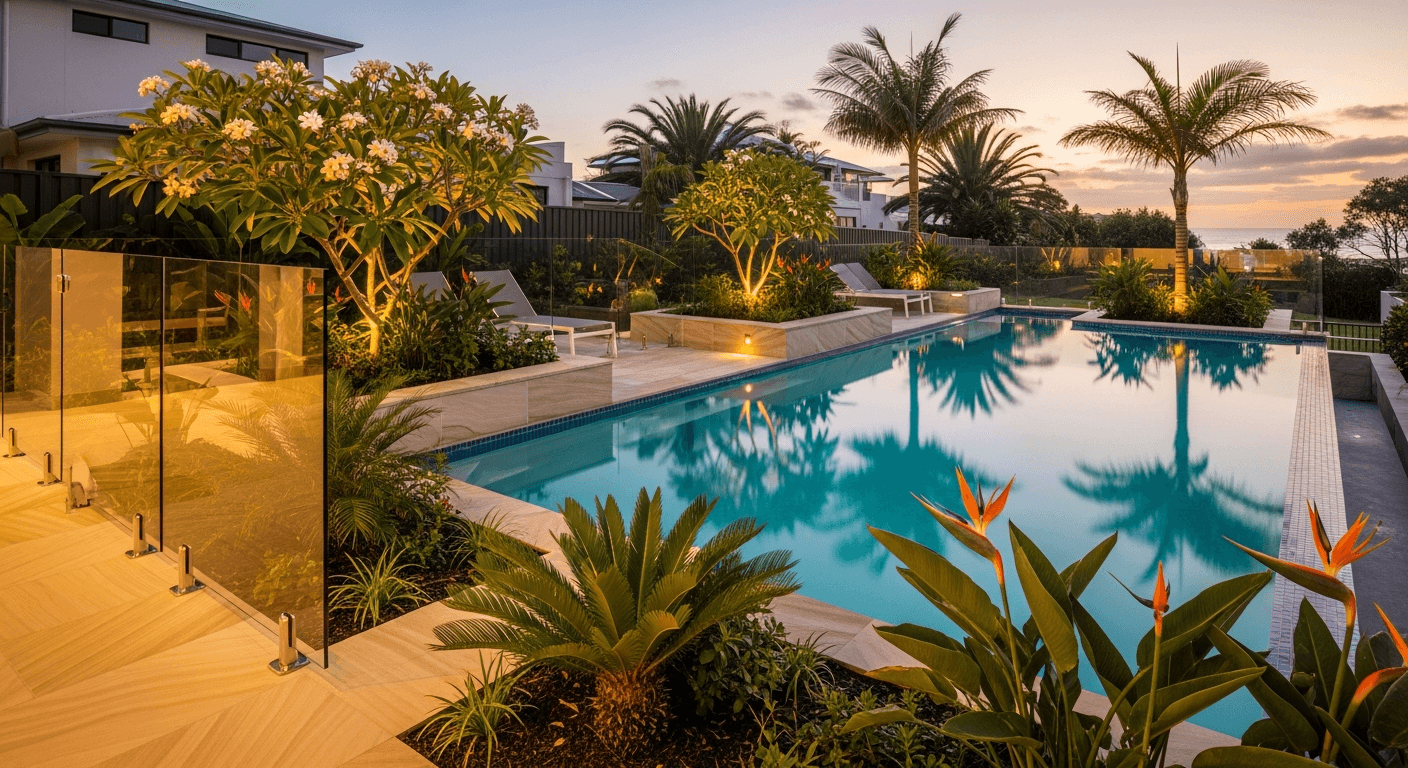
Directional spots aimed at trees, palms, sculptural plants, or architectural features. The single biggest aesthetic upgrade — a well-uplit frangipani or palm becomes the focal point of the entire garden at night.
- Cost installed: $250-$500 per fixture.
- Power: 5-10W LED, narrow beam (24° standard).
- Typical specs: Marine-grade brass body, IP65, fully adjustable head, glare control hood.
3. Wall washing
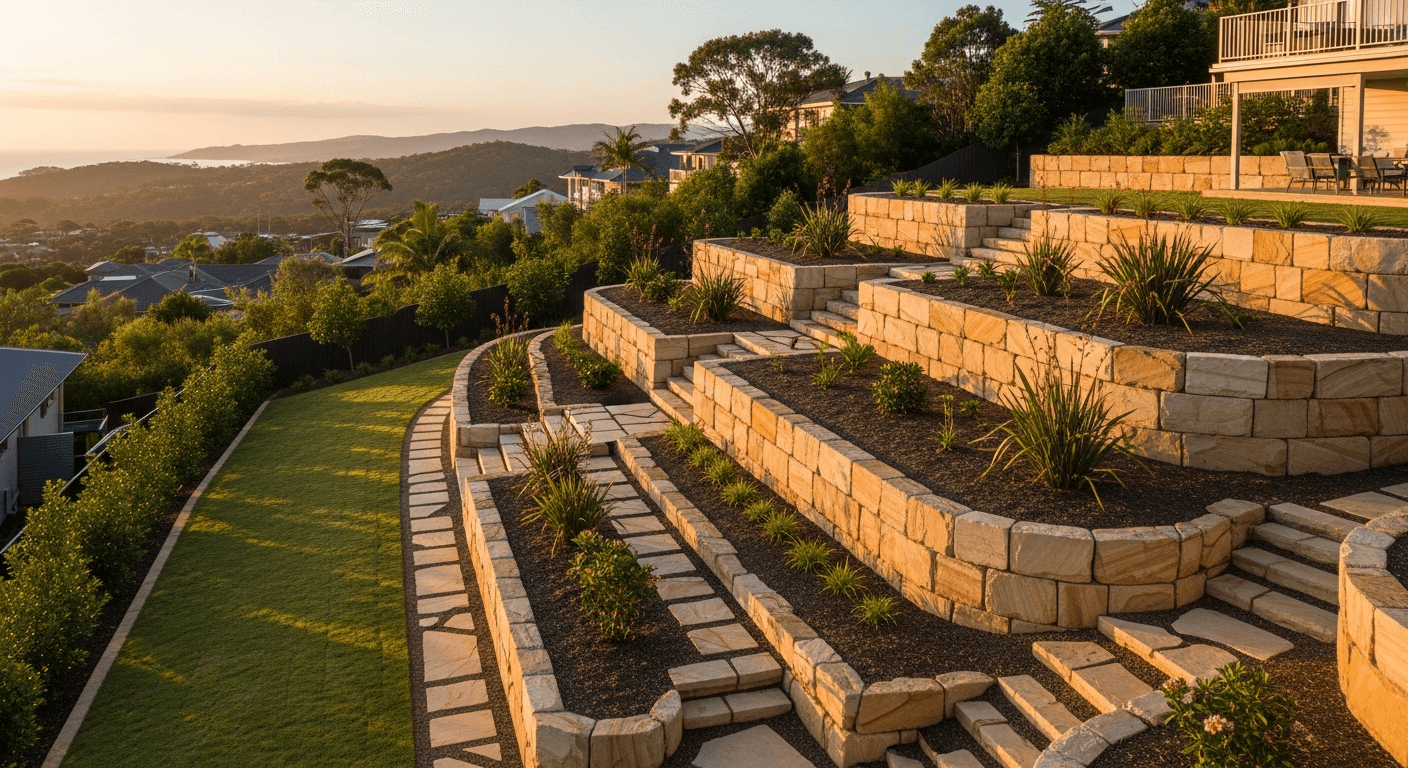
Wide-beam fixtures that illuminate flat surfaces — retaining walls, sandstone features, fences. Adds depth and dimension to night spaces.
- Cost installed: $200-$400 per fixture.
- Power: 5-10W LED, wide beam (60° typical).
4. Step + deck integrated lighting
Small recessed LEDs in stair risers, deck rim, retaining wall caps. Functional safety lighting that doubles as architectural detail.
- Cost installed: $80-$200 per fixture (lower because smaller).
- Power: 0.5-2W per fixture.
Why marine-grade brass matters on the Coast
The single biggest mistake in Gold Coast outdoor lighting: galvanised-steel or aluminium fittings within 3km of saltwater. Looks identical when installed. Within 18-24 months:
- Galvanised steel shows visible rust spots, pitting, and stains nearby surfaces.
- Aluminium develops white oxide bloom and corrosion at any contact point.
- Cheap plastic housings yellow and crack under UV exposure.
Marine-grade brass (60% copper, 30% zinc, traces of lead + tin) is corrosion-immune in salt air. Costs roughly 30-50% more than galvanised at purchase. Lasts 5x longer. The decision pays for itself on the first replacement avoided.
For high-output applications or in extreme exposure positions (within 100m of waterline), 316 stainless steel is the next step up.
Design principles for Coast outdoor lighting
Less is more
Over-lit gardens lose mystery. A great landscape lighting design might use 20 fixtures total on a 600sqm property — uplights on 3-4 key trees, path lights along key walkways, wall washing on one feature, and ambient deck lighting. The dark zones between lit zones are part of what makes it beautiful.
Light the feature, not the fixture
Outdoor light fittings should be hidden — buried in plant beds, set behind rocks, recessed into walls. You should see the illumination, not the light source. Glare shields, beam control, and proper fixture placement do this.
Layer the light
A good design uses three layers: ambient (general low-level lighting for navigation), task (specific functional zones like outdoor kitchens), and accent (feature highlights). Each layer on its own dimmer or scene control.
Match colour temperature
2700K throughout the residential garden. Don't mix 2700K and 4000K — the contrast reads sloppy. Pool lighting is an exception (5000K white or RGB scene control are fine in the pool itself).
Smart control and automation
Modern landscape lighting systems use a low-voltage transformer with a smart controller. The mid-range Coast standard:
- Casambi-controlled Australian transformers ($500- $1,200) — phone control, scenes, dim levels, dusk-to-dawn automation.
- Pre-set scenes:“Welcome home” (path + entry lights), “Entertain” (everything at 70%), “Late night” (just deck rim + a single feature).
- Astronomical timer: turns lights on at actual sunset time year-round, not at a fixed clock time.
For high-end Coast properties: KNX or Lutron HomeWorks integrates outdoor lighting with the rest of the home automation system. Adds $4,000-$10,000 but enables full home + landscape lighting orchestration.
Suburb-specific notes
- Surfers Paradise, Main Beach, Palm Beach: Beachfront / canal-front. 316 stainless steel preferred over brass for fixtures within 100m of waterline. Heavy salt aerosol means even premium fittings need annual rinse-cleaning.
- Burleigh Heads, Broadbeach: Mixed terrain — Coast standard marine-grade brass perfect. Hill properties get dramatic uplighting opportunities on slopes.
- Robina, Varsity Lakes, Merrimac: Standard residential lighting design — can use less premium fittings (powder-coated aluminium acceptable here) without short-term failure.
- Mudgeeraba, Tallai, Hinterland: Slope properties create great uplighting opportunities. Salt corrosion not a major concern but UV exposure on slopes accelerates plastic components.
Real installation costs
- Path + entry lighting (8-12 fixtures): $3,500-$5,500. Marine-grade fittings, smart control, professional install.
- Standard residential lighting design (15-25 fixtures): $6,500-$11,000. Adds feature uplighting, deck integration, multiple scenes.
- Premium full landscape lighting (30-50+ fixtures): $12,000-$25,000. Includes pool integration, water feature lighting, home automation integration, premium fixture grades throughout.
What to avoid (cheap install warning signs)
- Galvanised steel or aluminium fittings within 3km of coast.
- Plastic housings (UV-degrades fast on the Coast).
- 240V mains-voltage fixtures spread throughout the landscape (legal concerns; electrician required for every change).
- Cheap analog timers (drift, fail, no automation).
- Cool-white (4000K+) LED throughout.
- Buried cable without proper conduit or depth (gets damaged during future gardening).
Quick start
Building a landscape and want to plan the lighting from day one, or retrofitting lighting into an existing garden? Free design consult across the Gold Coast. We design with full marine-grade specifications and smart controls baked in. Reach out via the contact page or call 0485 032 685. For service-page overview see outdoor lighting.
Frequently asked
Common questions.
How much does outdoor lighting cost on the Gold Coast?
A complete residential landscape lighting design + install runs $4,000-$15,000 depending on scope. Path + feature lighting only: $4,000-$7,000 for a typical Coast block. Full design with pool lighting, deck lighting, feature uplights, wall washing, and automated control: $10,000-$20,000+. Marine-grade brass fittings (essential on the Coast) cost 30-50% more than galvanised steel but last 5x longer.
Why do I need marine-grade fittings on the Gold Coast?
Salt aerosol corrodes galvanised steel within 18-24 months on the Coast — fixtures pit, rust streaks onto pavers, and electrical connections fail. Marine-grade brass (or 316 stainless steel for industrial applications) is the only material that holds up long-term within 3km of saltwater. Spending more upfront on the right fittings saves 3-4 replacement cycles over the life of the system.
12V or 240V outdoor lighting — which is better?
12V (low-voltage) is the residential standard — safer, easier to install (no licensed electrician needed for the wiring runs beyond the transformer), and more flexible for design changes. 240V is required for high-output applications (security floodlights, larger feature lights, automated gate lighting). A typical Coast install is 90% 12V with a few 240V circuits for specific applications. Always 240V to weather-rated IP67 transformers placed in protected positions.
Are smart outdoor lighting controls worth the upgrade?
Yes — particularly on Coast properties. Phone control + scene presets + automatic dusk/dawn timing add maybe $400-$1,000 to a typical install and meaningfully change how people actually use the system. Cheap analog timers fail or drift; smart controllers (Casambi, Litecontrol, KNX for high-end) stay reliable and integrate with home automation.
What's the best colour temperature for Coast outdoor lighting?
2700K (warm white) is the residential Coast standard — feels natural at dusk and complements timber, sandstone, and tropical planting. Avoid 4000K and above (cool white) — it reads industrial and clashes with the warm coastal aesthetic. Pool lights are an exception (5000K white or RGB are fine in the pool itself). High-end designers sometimes use 2200K (extra warm) for pure feature lighting on stone walls and palm uplights.
How energy-efficient is modern outdoor lighting?
LED is the only choice — modern path lights run 1.5-3W per fixture, feature uplights 5-10W. A complete 20-fixture landscape lighting system uses 100-200W total, less than two old halogen downlights. Annual running cost on a typical install: $40-$80 if running 4 hours a night.
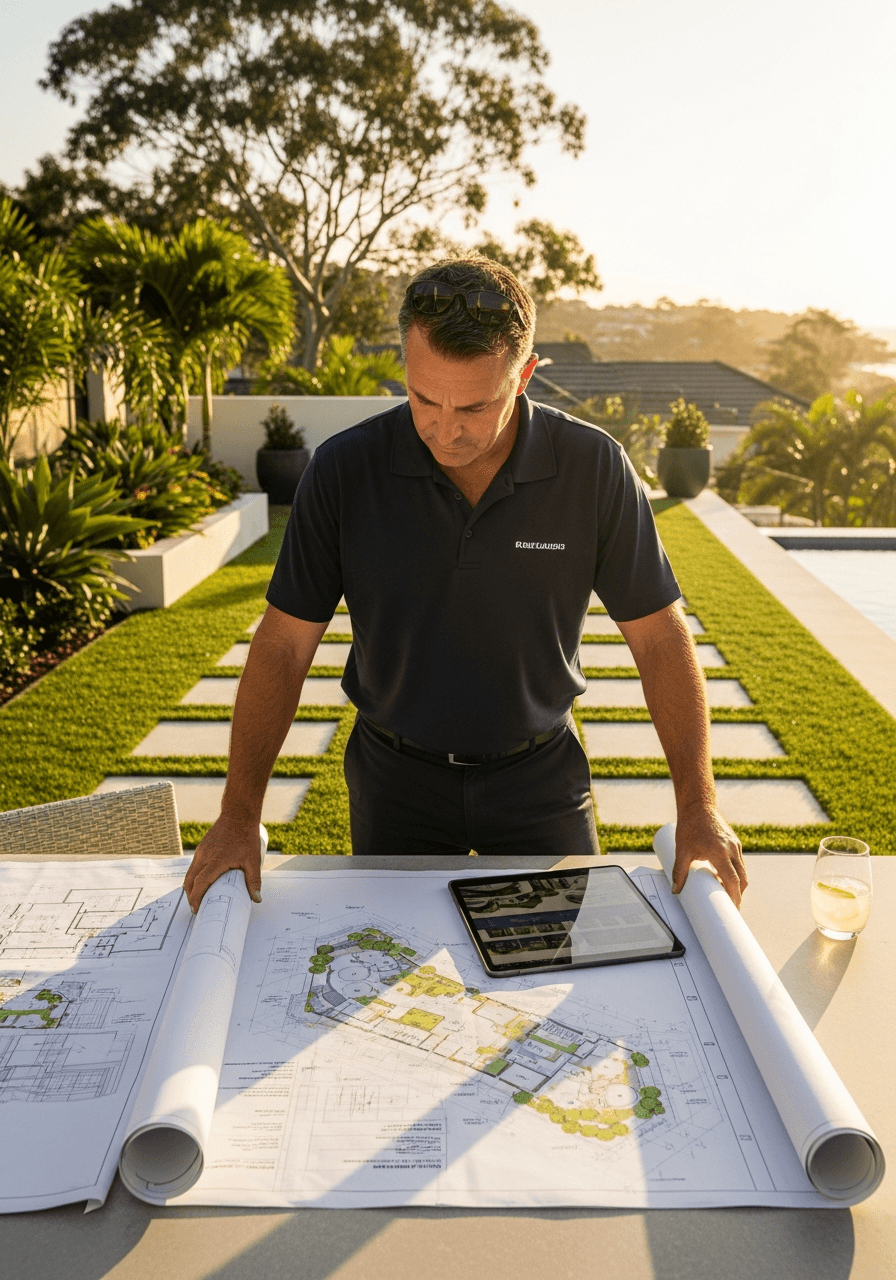
Written by
Riley Penn
Founder, Lux Landscaping
Riley is the founder of Lux Landscaping, Cert III qualified in Landscape Construction and QBCC licensed on the Gold Coast. Every Lux quote and consultation comes through him personally — and these guides are written to share what he's learned about doing landscaping properly in the Gold Coast climate.
Ready to start?
Let's talk about your project.
Free site visit. Detailed itemised quote within 24 hours. Reach Riley directly.