Sloping Block Landscaping Gold Coast: How to Tame a Tricky Yard
A sloping block isn't a problem to solve — it's a feature to design around. Some of the most striking gardens on the Gold Coast sit on blocks that owners once thought were unusable. The Hinterland suburbs, the western edges of Currumbin and Burleigh Heads, and most of Tallai are full of these blocks. The trick is knowing the four moves that actually work — and where the money has to go up front.
This article walks through how Lux approaches sloping blocks: how to read the fall on your land, what terracing actually costs, which materials handle our climate, and what to plant once the structural work is done.
Why sloping blocks need a completely different approach
On a flat block, you can design from the surface down — pick the look, then figure out the construction. On a sloping block you have to design from the engineering up. Every aesthetic choice depends on a structural choice that precedes it. Get the structure wrong and the planting fails; the paving cracks; the lawn washes away in the first wet season.
The four moves that make sloping blocks work — in the order they have to happen:
- Read the fall(what's actually happening across the block).
- Terrace the slope (break it into usable level zones).
- Drain it properly(so the soil doesn't leave with the next storm).
- Plant it to hold (deep-rooting species that fix the soil permanently).
Reading the fall: 1-in-10, 1-in-5, or worse
Surveyors describe slopes as ratios — a 1-in-10 fall drops 1 metre for every 10 horizontal metres. A 1-in-5 drops 1 metre for every 5. On the Gold Coast you see roughly:
- 1-in-10 or gentler: Most central suburbs (Robina, Bundall, Merrimac, Varsity Lakes). Mild slope, easy to landscape with low retaining or gentle grading.
- 1-in-5 to 1-in-7: Coastal hill zones (parts of Burleigh Heads, west Currumbin, Tugun escarpment). Needs at least one significant retaining tier — usually 800mm to 1.2m height.
- Steeper than 1-in-5: Hinterland (Mudgeeraba, Tallai, Bonogin, Worongary). Multiple terraces required; almost always involves engineered walls over 1m and council approval. Heavy excavation, deep footings, real drainage system.
Most sloping-block jobs on the Coast sit in the second category. We'll measure the fall in the first 15 minutes of a site visit — usually with a digital level on a 4m rod — and the rest of the quote follows from that number.
Terracing: the move that unlocks the rest
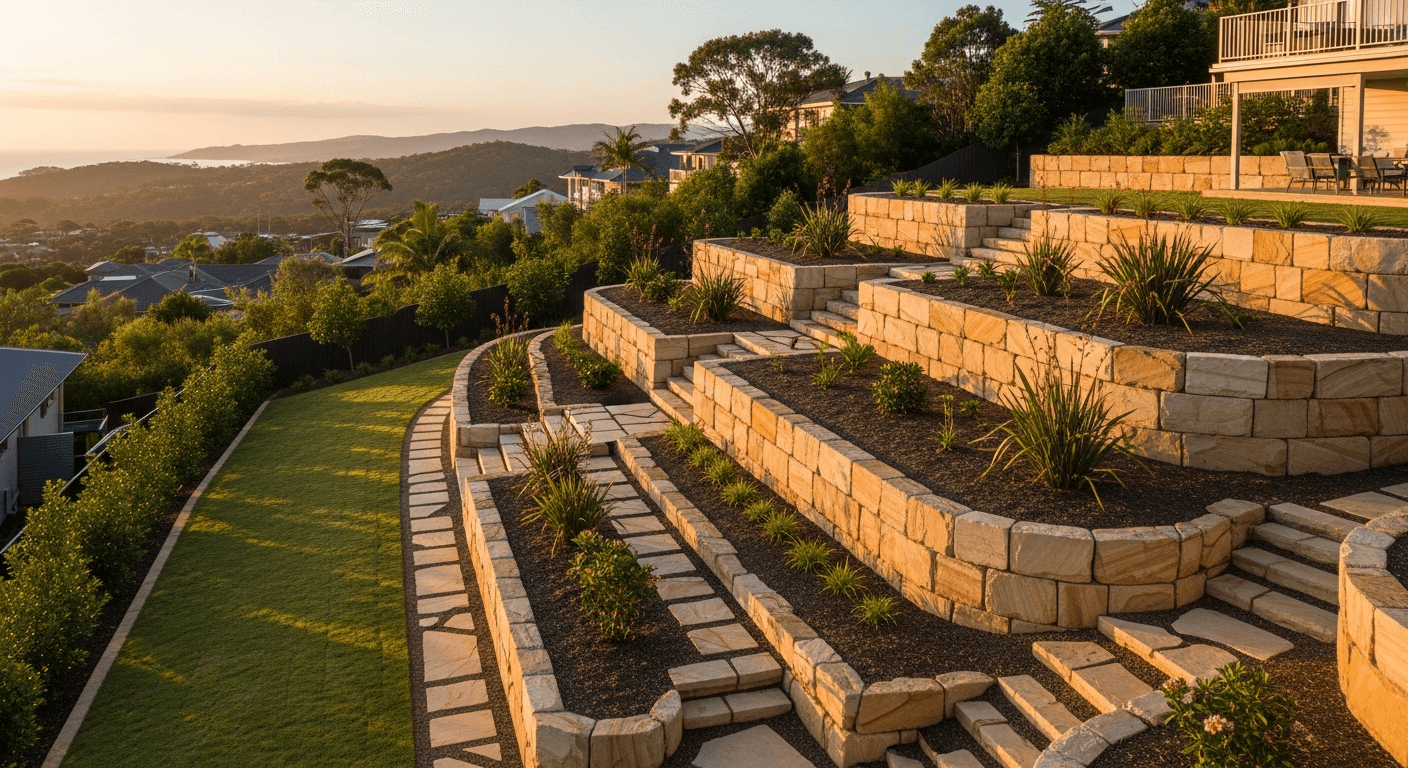
Terracing means breaking a slope into multiple level zones, separated by retaining walls. Done well, it turns an unusable hillside into 2-4 distinct garden rooms — entertainment area at the top, fire pit in the middle, native planting at the bottom, for example.
Three rules I work to:
- Each terrace should be at least 3m wide. Anything narrower feels like a ledge, not a usable zone.
- Retaining heights should match the use of the zone above. A terrace holding a paved entertaining area can take a 1.5m wall comfortably; one above a planted slope can be 600-800mm without dominating.
- Sight lines matter. Tier the slopes so you can see from the house to the most distant terrace — broken sight lines make sloping yards feel chopped up.
Materials for retaining vary with site conditions and budget. The full breakdown is in our dedicated retaining walls Gold Coast guide — read that one first if you're scoping a sloping-block project. Generally on hinterland slopes we recommend sandstone block (lasts 50+ years, weathers well) or engineered concrete with sandstone cladding (cheaper structural cost, same finished look).
Drainage is non-negotiable
The most common sloping-block failure on the Gold Coast is a yard that was terraced beautifully — but never drained. The first big storm hits, water builds up behind the retaining walls, soil washes through the joints, mulch floats off, and the slope turns into a creek bed.
Proper sloping-block drainage includes:
- Slotted ag drain (65mm sock drain) behind every retaining wall, sloped 1:100 across the terrace to a stormwater outlet.
- Catch pits at the top of the slope to intercept run-off from uphill neighbours before it enters your terraces.
- Surface drainage on paved zones — grates, channel drains, or shaped fall to dry-creek beds.
- Soak wells or rain garden bioswales at the bottom of the slope to absorb the slow-release water from upstream terraces.
On every Lux job we map the drainage plan during design and you see it on the quote as a separate line item. It typically runs 10-15% of the total project cost — and it's the cheapest insurance policy you'll buy.
Planting a slope so it stays put
Plants are the long-term structural element. Once the retaining is in and the drainage is working, planting is what locks the slope in for the next 20 years.
The species we use consistently on Gold Coast slopes:
- Lomandra confertifolia “Little Con” — bombproof, dense root system, handles wet + dry equally. Plant in dense drifts on terrace edges.
- Dianella caerulea “Cassa Blue” — fine blue-green foliage, native, deep rooting. Excellent mid-storey companion to lomandra.
- Hardenbergia violacea — vigorous Australian native groundcover with purple flowers. Holds slopes fast and spreads.
- Grevillea “Bronze Rambler” — prostrate grevillea that blankets ground with red flowers. Attracts native birds, holds soil beautifully.
- Kangaroo paw (Anigozanthos flavidus types)— taller feature plant, hardy in subtropical conditions, deep root system. Don't use smaller flavidus varieties — they're less hardy on the Coast.
Plant dense (15-20% closer than nursery spacing) and mulch heavily. Within 18 months the slope will be a solid plant matrix that doesn't need ongoing replanting. For a deeper planting guide for the Coast, see best plants for Gold Coast gardens.
The hinterland special: rock excavation
Properties in Mudgeeraba, Tallai, and the upper western edges of Currumbin often hit rock during excavation. We'll core-drill or rip with a rock breaker as needed — this adds time and cost but isn't avoidable. We always budget for a 20% rock contingency on hinterland sloping blocks; if we don't hit it, that comes off the final invoice.
Real cost on a sloping block
Indicative ranges for a 600sqm sloping block on the Gold Coast:
- Mild slope (1-in-10), 1 retaining tier, simple landscape: $25,000–$50,000 turnkey.
- Coastal hill (1-in-5 to 1-in-7), 2 retaining tiers, full transformation: $60,000–$120,000.
- Steep hinterland (steeper than 1-in-5), 3+ tiers, engineered walls, rock excavation: $120,000–$250,000+.
These ranges assume a complete design + build with all four moves (terracing, drainage, planting, finishing). For a quote that breaks down exactly where the money goes on your specific block, head to the contact page or call 0485 032 685. We do free first site visits across the Gold Coast.
Frequently asked
Common questions.
What's the cheapest way to landscape a steep block?
Honest answer: there isn't one. Sloping blocks need terracing, retaining, and drainage no matter what aesthetic you go for — those three structural elements are 60-70% of the budget on any hillside project. The savings come from material choice (timber sleeper terraces vs sandstone), planting density (smaller specimens grown out vs mature plants installed), and how much hardscape you opt into. Expect roughly 30-50% more total spend than the equivalent flat-block project.
Do I need an engineer for a sloping block landscape?
If you're building any retaining wall over 1 metre, yes — Gold Coast Council requires engineered design. For terracing under that height, an engineer isn't legally required but is still worth getting on properties with significant drainage flow or unstable soil. We can lodge an engineering brief on your behalf and have the cert ready before excavation starts.
How long does a sloping block landscape take to complete?
Roughly double the timeline of a flat block — 6 to 10 weeks for most full transformations. The extra time is mostly excavation and retaining wall construction. Plant establishment also takes longer on slopes because irrigation has to work against gravity, so we usually allow 6-8 weeks of staged planting once the structural work is finished.
Will a sloping yard always need stairs?
Not always, but most over a 1m fall benefit from at least one set. Sandstone-block stairs are the Gold Coast standard — durable, weather well, and fit any aesthetic. We design stair runs so they don't break the line of sight from the back of the house to the bottom of the slope, which is a common mistake that makes yards feel chopped up.
How do you stop water washing soil away on a slope?
Three things working together: retaining (holding soil back at the terrace edge), drainage (slotted ag drains carrying water sideways across each terrace), and groundcover (dense planting that locks soil in once established). Mulch alone isn't enough — heavy Gold Coast wet-season rain will strip an unmulched or unplanted slope in one storm.
What plants work best on a hillside garden?
Tough, deep-rooting natives and Mediterranean species. Lomandra (especially Lomandra confertifolia 'Little Con'), kangaroo paw, flax lily, native rosemary, hardenbergia and grevillea all hold soil and survive both Coast rainfall and the drier periods. Avoid shallow-rooted ornamentals like agapanthus on steep ground — they wash out.
Written by
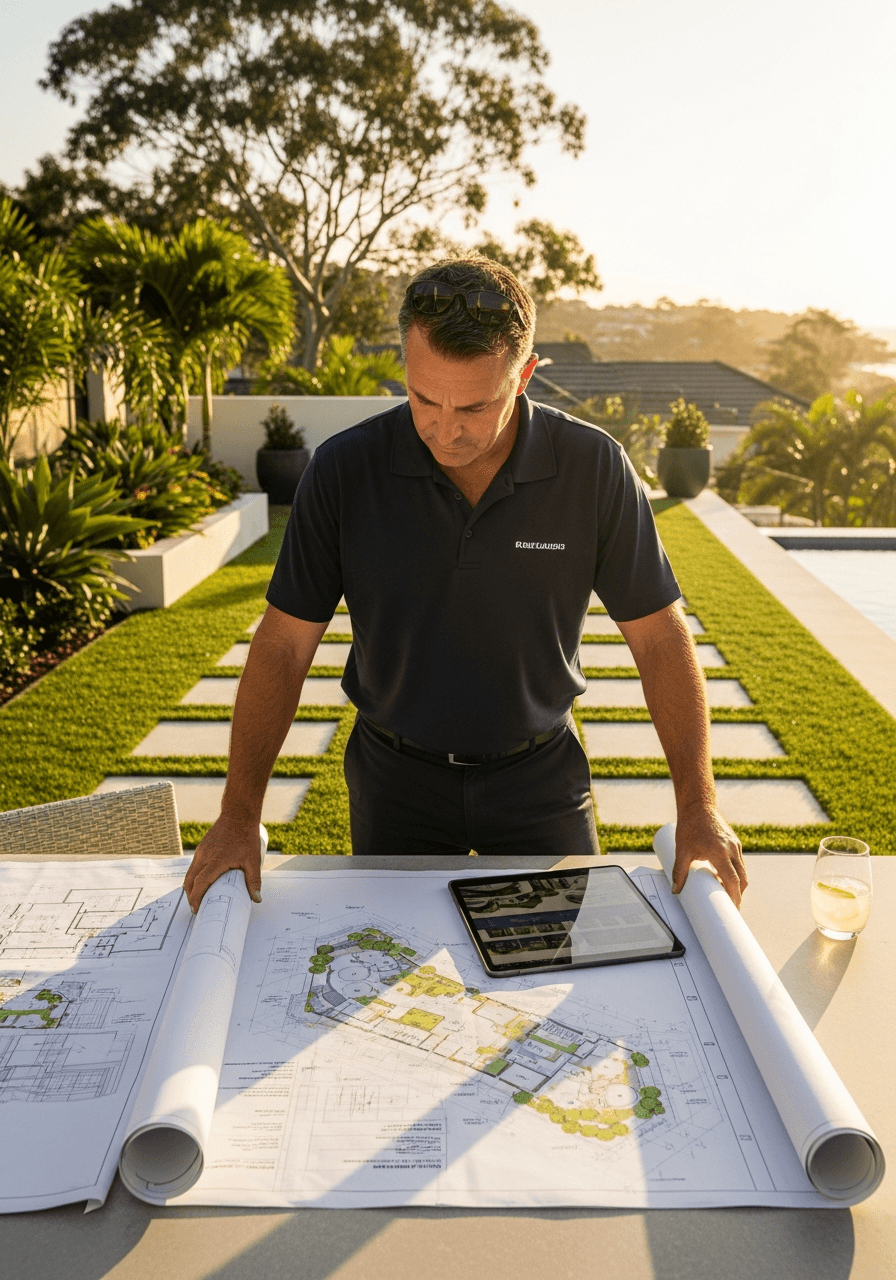
Riley Penn
Founder, Lux Landscaping
Riley is the founder of Lux Landscaping, Cert III qualified in Landscape Construction and QBCC licensed on the Gold Coast. Every Lux quote and consultation comes through him personally — and these guides are written to share what he's learned about doing landscaping properly in the Gold Coast climate.

Ready to start?
Let's talk about your project.
Free site visit. Detailed itemised quote within 24 hours. Reach Riley directly.