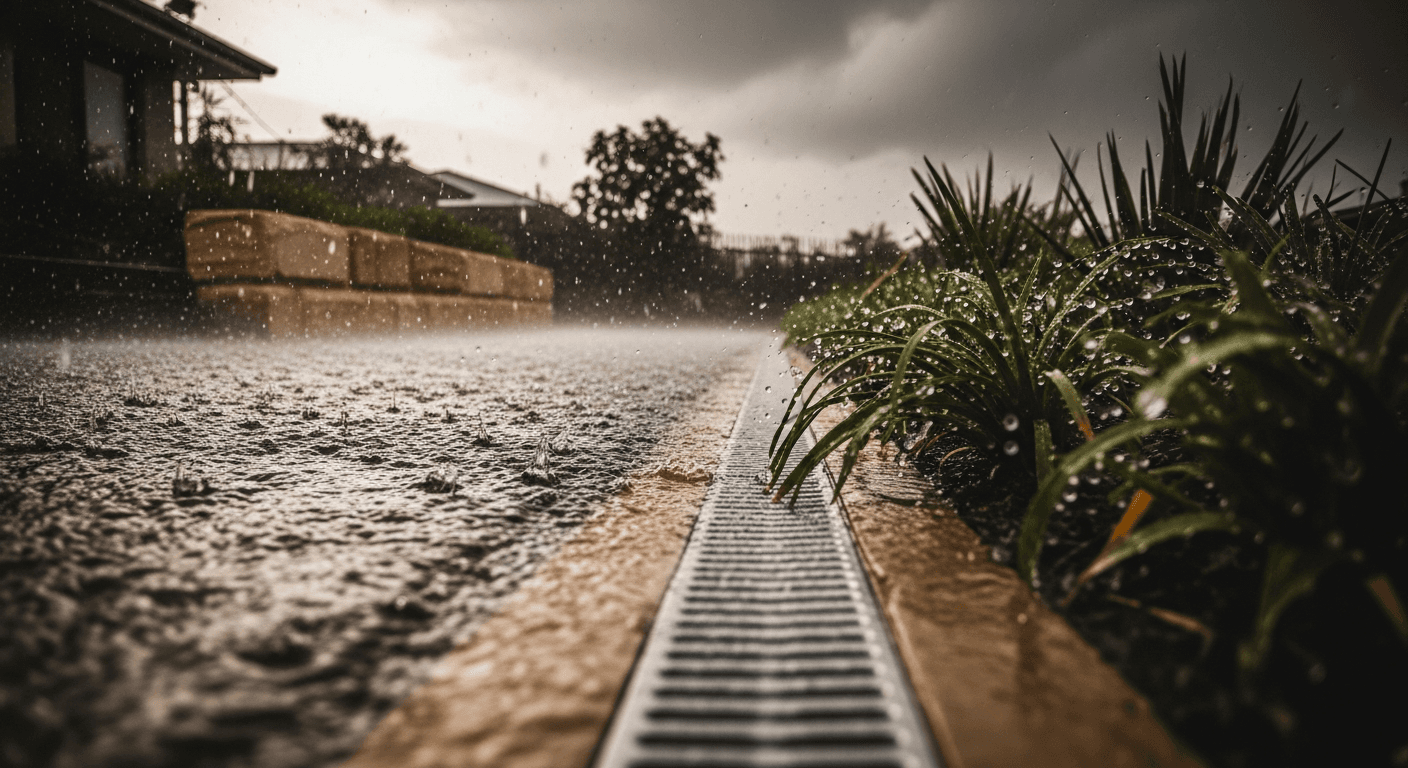
Drainage Solutions for Gold Coast Storm Season: Why Most Gardens Fail
Every February and March, the same problems show up in Gold Coast gardens. Beds that flood and won't drain. Retaining walls that start to bulge. Plants that drown after a big storm. Almost always, it traces back to one thing: drainage that was never properly designed for the Gold Coast wet season.
The Gold Coast averages 1,400mm of rain a year — most of it concentrated in five months. We regularly see 200-300mm storms in February, and the cyclone- fringe events (every 2-3 years) can dump twice that in 48 hours. A landscape designed without serious drainage isn't a landscape — it's a countdown timer.
This article covers why most Gold Coast gardens fail in storms, what proper drainage actually looks like, and what to fix before the next wet season.
Why most Gold Coast gardens fail in storms
Three patterns repeat themselves on virtually every flooded property I'm called to:
- Surface runoff has nowhere to go. Paving slopes towards plant beds. Driveways shed water onto front lawn. Patios shed water onto turf. Nothing intercepts it before it saturates soil.
- Retaining walls have no drainage layer. Water pools behind the wall, hydrostatic pressure builds, wall bulges or fails.
- Stormwater connections are missing or inadequate.Even where there's a stormwater pit, the ag drain that should connect to it either was never installed or has been crushed by tree roots over time.
On its own, any one of these is manageable. Combined, they create the classic Gold Coast wet-season disaster: lawn full of standing water, retaining wall bulging, plant beds drowning, and stormwater backflow under the house.
The four layers of proper landscape drainage
Layer 1: Surface drainage (channel drains)
Linear grates that sit flush with the surface, catching surface water before it floods paving or gardens. Essential at:
- The boundary between hardscape and turf (where paving sheds water onto lawn).
- The base of slopes (where overland flow concentrates).
- Around pool edges (catching overflow + splash-out).
- At driveway entrances (preventing street runoff entering property).
Channel drain cost: $200-$400 per linear metre installed, including stormwater connection. Specify polymer concrete channels rated for vehicle loading where relevant.
Layer 2: Subsurface drainage (ag drains / sock drains)
Slotted 65mm or 100mm PVC pipe wrapped in geo-fabric (the “sock”), buried in an aggregate trench. Collects subsurface water and groundwater seepage. Essential at:
- Behind every retaining wall (preventing hydrostatic pressure).
- Under garden beds adjacent to slopes (catching slope seepage).
- Across low-lying areas (lifting watertable).
- Around pool decks (catching saturation from splash + planting).
Ag drain cost: $80-$150 per linear metre installed depending on depth and aggregate volume. Sloped 1:100 minimum, connected to stormwater outlet.
Layer 3: Stormwater connection or soak well
All collected water needs somewhere to go. Two options:
- Council stormwater connection — preferred where available. A plumber connects your drainage to the street stormwater main. Cost: $1,500-$4,000 depending on excavation distance.
- Soak well— underground chamber that holds water while it infiltrates into surrounding soil. Used on properties without street stormwater access or where there's no easement to neighbours' systems. Cost: $2,500-$6,000 installed. Not suitable on heavy clay or low-lying sites.
Layer 4: Slope shaping (surface contouring)
The cheapest drainage system is gravity. Done well, the surface of your property guides water to drainage pits before it has a chance to pool. Every Lux landscape design includes surface contouring as part of the build — usually a 1:80 fall away from the house, 1:50 fall on paved entertaining areas, and bermed garden beds that direct flow rather than catching it.
The retaining wall connection
Half the failed retaining walls on the Coast aren't structural failures — they're drainage failures. Water builds up behind a wall with no ag drain. Hydrostatic pressure pushes the wall outward. Mortar joints crack. Sleepers split. Within 2-3 wet seasons the wall is unrecoverable.
Every retaining wall over 600mm needs:
- Geo-fabric layer against the wall back.
- 20mm aggregate backfill behind the geo-fabric.
- 65mm sock drain at the base of the aggregate, sloped to outlet.
- Outlet to stormwater or soak well — never “daylighting” into the garden bed below.
For full retaining wall design info, see our retaining walls Gold Coast guide.
Suburb-specific drainage notes
- Surfers Paradise, Main Beach, Broadbeach: Low-lying canal-front properties. Watertable typically 1.5-2m below ground; flooding from below as well as above. Often need pumped drainage or specifically designed bioswales rather than soak wells.
- Mudgeeraba, Tallai, Hinterland: Sloping blocks with overland flow from uphill neighbours. Catch pits at top of property + ag drain network across slopes. Heavy mulching to prevent surface erosion.
- Robina, Varsity Lakes, Merrimac: Flat suburban blocks with moderate clay content. Stormwater connection available; surface drainage matters more than subsurface; bermed garden beds guide water effectively.
- Burleigh Heads, Palm Beach: Mixed terrain — beachfront flat, hillside steeper. Drainage approach depends on the specific block — site assessment essential.
What to fix before next wet season
Walk your property after the next moderate rain. Watch where the water actually goes. Then fix in this priority order:
- Anywhere water pools.Standing water 2+ hours after rain stops = a saturated zone that's killing plants and undermining structures.
- Anywhere water flows onto paving from gardens. Soil washes out, paving stains, joints fill with sediment.
- Behind any retaining wall over 600mm. Check for damp patches, bulging, mortar cracking.
- Where downpipes discharge. They should connect to stormwater — not just empty onto the lawn or into garden beds.
Quick start
We do free drainage assessments across the Gold Coast — most consults are 45 minutes on site, you get a clear written report of what's wrong and what it costs to fix. Reach out via the contact page or call 0485 032 685. Best to book before October if you want fixes done before peak storm season.
Frequently asked
Common questions.
How much rain does the Gold Coast get during storm season?
The wet season runs roughly November through April, with peak rainfall in February and March. Average annual rainfall is 1,400mm, but the Coast regularly sees 200-300mm in a single storm. Cyclone-fringe events (declared every 2-3 years) can dump 400-600mm over 48 hours. Drainage systems designed for 100mm/hr peak flow will be overwhelmed in a serious wet season — design for 150-200mm/hr where you can.
What's the cost to install proper landscape drainage?
Depends entirely on scope. A single ag drain run with stormwater connection: $1,500-$3,500. Whole-yard drainage with multiple ag drains, channel drains, and a soak well: $5,000-$15,000. Pumped drainage on low-lying sites (Coast canal areas): $8,000-$20,000+. The cost of retrofitting drainage after landscape installation is roughly 2-3x doing it as part of the initial build — always design drainage first.
Do I need a permit to install landscape drainage?
Surface drainage and ag drains within your property boundary don't require council approval. Connections to stormwater mains do — you need a plumber to make the legal connection and complete a Form 4. Any drainage modification that changes overland flow paths or affects neighbours can also require approval. We handle all approvals as part of any project that needs them.
What's the difference between ag drain and channel drain?
Ag drain (or 'sock drain') is a slotted PVC pipe wrapped in geo-fabric, buried in an aggregate trench. It collects subsurface water and groundwater seepage. Channel drain (or 'strip drain') sits flush with the surface — a grated linear drain that catches surface water before it floods paving or gardens. Most properties need both: ag drains for soil saturation, channel drains for runoff.
Can I just use a downpipe instead of installing drainage?
Downpipes carry roof water to stormwater, which is good. But they don't address surface runoff from paths, lawns, or overland flow from uphill properties. Roof water is maybe 20-30% of the wet-season water load on a Gold Coast block — the other 70-80% is uncaptured unless you install proper landscape drainage. Single biggest mistake we see: relying on downpipes alone.
What's a soak well and when do I need one?
A soak well is an underground chamber (usually 1,000-3,000 litre capacity, perforated concrete or plastic) that holds stormwater while it slowly infiltrates into the surrounding soil. Useful on properties where you can't legally connect drainage to council stormwater (back of block, no street frontage, restricted easements) or where ground is highly permeable. Cost: $2,500-$6,000 installed. Not suitable on clay or saturated low-lying sites — the water won't infiltrate fast enough.
Written by
Riley Penn
Founder, Lux Landscaping
Riley is the founder of Lux Landscaping, Cert III qualified in Landscape Construction and QBCC licensed on the Gold Coast. Every Lux quote and consultation comes through him personally — and these guides are written to share what he's learned about doing landscaping properly in the Gold Coast climate.
More from the Lux blog
Keep reading.

Ready to start?
Let's talk about your project.
Free site visit. Detailed itemised quote within 24 hours. Reach Riley directly.