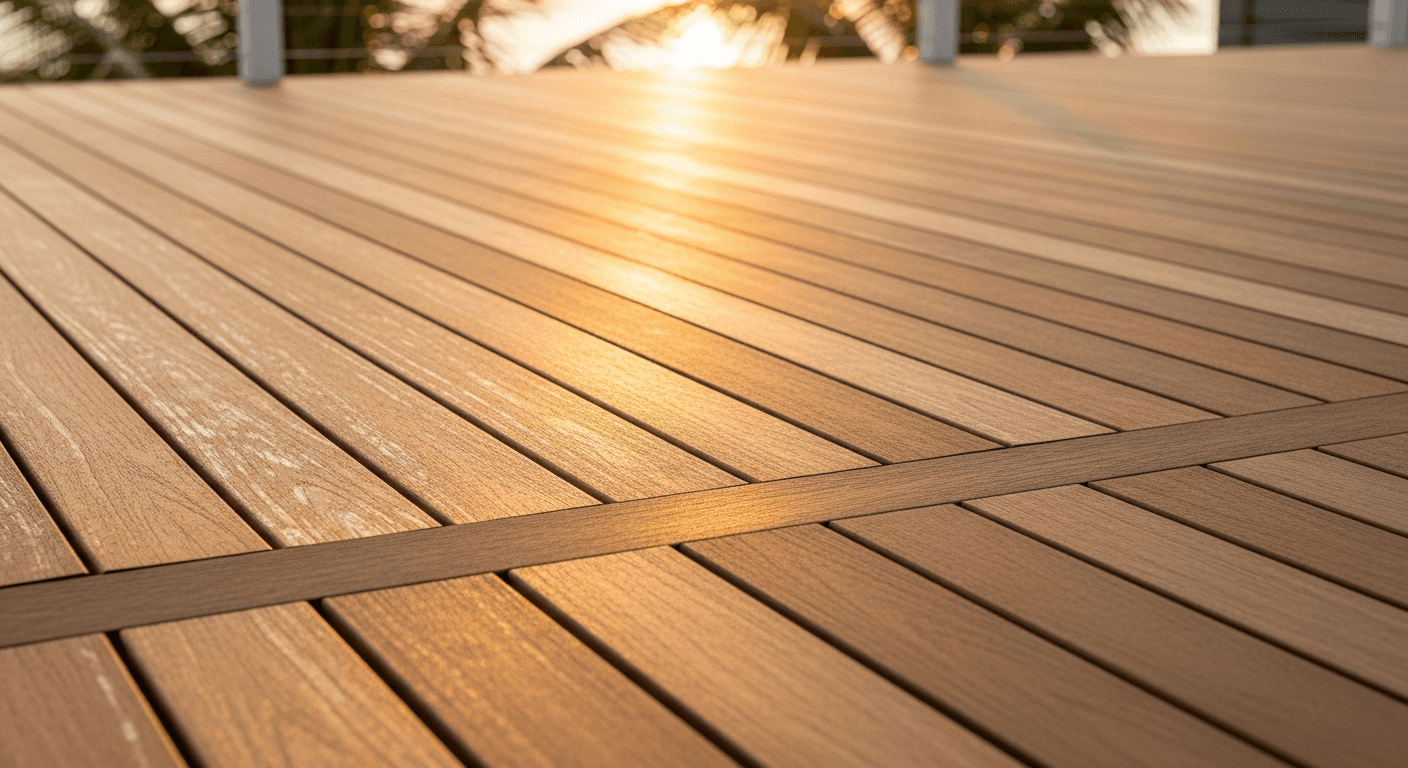
Composite vs Hardwood Decking: Which Survives Queensland Salt and UV?
Decks on the Gold Coast face three forces that don't exist anywhere else in Australia at the same intensity: tropical UV, salt aerosol, and seasonal humidity swing (50% in winter to 90% in summer). Choosing the right material isn't about which one looks better in a showroom — it's about which one's still looking good in year ten on YOUR site.
This guide compares the two main options — hardwood and composite — through the lens of Coast performance. Plus the honest answer on which costs more over the lifetime of the deck.
Hardwood decking on the Gold Coast
Hardwood means actual timber — usually Australian eucalypt or rainforest species like spotted gum, blackbutt, ironbark, jarrah, or merbau. The Coast standard is spotted gum.
Spotted gum (Corymbia maculata)
- Durability class: Class 1 (50+ year service life above ground).
- Colour: Honey-brown to chocolate, beautiful natural variation.
- Salt tolerance: Excellent (highest of any common Australian hardwood).
- UV behaviour: Silvers naturally over time if not oiled — some Coast designers prefer this aged look; most homeowners maintain the warm colour with oil.
- Cost installed: $300-$400 per square metre.
- Maintenance: Re-oil every 12-18 months. Light sand if re-oiling is skipped for 3+ years.
Blackbutt (Eucalyptus pilularis)
- Durability class: Class 2 (15-25 year service life).
- Colour: Pale honey to light brown — modern, contemporary look.
- Cost installed: $250-$330 per square metre.
- Best for: Coast properties wanting a lighter aesthetic; shaded or partial-shade locations.
Merbau
- Cost installed: $200-$260 per square metre (cheapest option).
- Catch: Sourced from Southeast Asian rainforests, with serious ethical questions. Also tannin-leaches onto stone and concrete below for the first 18 months.
- Recommendation: Avoid unless certified FSC and you have no surface below the deck. Spotted gum is barely more expensive and dramatically better.
Hardwood pros + cons summary
Pros: Authentic natural finish, ages beautifully when maintained, repairable (sand and re-oil), highest grade lasts 50+ years.
Cons: Annual or biannual oiling required; splinters as it ages without maintenance; colour variation can be uneven across boards.
Composite decking on the Gold Coast
Composite means a manufactured board made from recycled wood fibres and plastic (HDPE or PVC). Mid-range and premium brands like Trex Transcend, EnviroSlat, and ModWood Sienna are the Coast standards.
- Durability: 20-25 year manufacturer warranties on premium grades; real-world lifespan often longer.
- Salt tolerance:Excellent — composite doesn't corrode or absorb salt aerosol.
- UV behaviour: Initial 6-12 month colour shift (fade), then stable. Premium brands have UV-stabilisers that minimise this.
- Cost installed: $350-$500 per square metre depending on brand and finish.
- Maintenance: Annual clean with soft brush + mild detergent. No oiling, no sealing, no sanding.
Composite pros + cons summary
Pros: Low ongoing maintenance, consistent appearance, no splintering, salt-immune, often comes in pre-fabricated systems with concealed fixings.
Cons: Higher upfront cost; gets hotter than hardwood in direct sun (especially dark colours); not repairable in the way hardwood is (a damaged board needs replacement); colour fades in first 6-12 months; synthetic feel under bare feet.
The Queensland salt and UV test
Stress-testing both materials against three Coast realities:
1. UV exposure
Spotted gum loses surface colour gradually without oiling, but doesn't structurally degrade. Composite loses initial colour in the first year then stabilises. Both perform acceptably; spotted gum requires maintenance to keep its appearance, composite doesn't.
2. Salt aerosol
Both salt-tolerant. Spotted gum's natural oils repel salt; composite's plastic substrate is impervious. Within 3km of the coast, both perform equally well — the choice is aesthetic, not functional.
3. Humidity + thermal cycling
Hardwood expands and contracts with humidity — this is what causes board gaps to open and close seasonally. Quality installation accounts for this (5-7mm winter gap, closes to 2-3mm in summer humidity). Composite doesn't move with humidity but does expand and contract with temperature — a 6m board can move 15-20mm seasonally, which good installation handles with end-gaps and breaker boards.
Lifetime cost comparison
Over 25 years on a 40sqm deck:
| Item | Hardwood (spotted gum) | Composite (premium) |
|---|---|---|
| Initial install | ~$14,000 | ~$18,000 |
| Oil + maintenance (25 years) | ~$5,000-$7,000 | ~$1,000-$1,500 |
| Repair / replacement at year 20 | $2,000-$3,000 partial | $0-$1,000 |
| 25-year total | ~$22,000 | ~$20,500 |
Composite wins on lifetime cost by a small margin once you factor in maintenance. The decision usually comes down to aesthetics — do you want a deck that ages and gains character, or one that stays consistent?
Substructure: the part that matters more than the boards
The decking surface gets all the attention but the substructure is what determines whether the deck lasts 20 years or 5. Coast-specific substructure notes:
- Joists: H4 treated pine minimum, or hardwood (treated pine is fine if properly capped and ventilated; hardwood preferred for coastal saltfront).
- Bearer spacing: 1.8m max centres for residential decks.
- Joist spacing: 450mm centres for hardwood, 400mm for composite (most composite manufacturers spec tighter).
- Fasteners: Stainless steel within 3km of coast. Galvanised steel rusts visibly within 18 months at the beachfront.
- Concealed clips: Use them. Top-fixed screws look cheaper and create water entry points that rot hardwood decks from below.
- Ventilation: 100mm minimum clearance under joists for air flow; otherwise humidity rots from below.
Which to choose — by use case
- Premium aesthetic, willing to maintain: Spotted gum. Best-looking surface, best ageing, best repairability.
- Low-maintenance priority, modern aesthetic: Premium composite (Trex Transcend, EnviroSlat Cladding+).
- Pool surround, heavy splash + barefoot use: Spotted gum (cooler underfoot) or mid-tone composite (light colours stay cooler).
- Saltfront beach exposure, less than 200m to waterline: Composite or spotted gum both work; composite needs less maintenance in this zone.
- Budget-driven, prepared to maintain or replace at year 15: Blackbutt hardwood — cheapest entry that still performs honestly.
For the full decking service overview, see our decking & outdoor living page.
Quick start
Building or replacing a deck on the Gold Coast and not sure which material suits your site? Free site visit + recommendation, no obligation. Reach out via the contact page or call 0485 032 685. Happy to do a sample comparison on-site so you can see hardwood and composite next to each other in your light.
Frequently asked
Common questions.
How much does decking cost on the Gold Coast?
Hardwood decking (spotted gum, blackbutt, merbau) runs $250-$400 per square metre installed depending on species and grade. Premium composite ($350-$500/sqm) costs more upfront but eliminates ongoing oiling and refinishing. A typical 40sqm deck installed: $10,000-$16,000 hardwood, $14,000-$20,000 composite. Substructure, fasteners, and stair work add to both numbers.
What's the best hardwood for Gold Coast decking?
Spotted gum is the Coast standard — Class 1 durability (50+ years above ground), beautiful colour variation, salt-tolerant, handles UV well. Blackbutt is the budget alternative — slightly less durable but lighter colour and easier to source. Merbau is cheap and consistent but ethically questionable (rainforest timber) and has a tendency to leach tannins onto pavers below. Iron bark is overkill for residential — too hard to fasten through.
Does composite decking really not need maintenance?
Less, not none. Quality composites (Trex, EnviroSlat, ModWood Sienna) need annual cleaning with a soft brush and mild detergent — same as hardwood. They don't need oiling or sealing. They DO fade over the first 6-12 months (which manufacturers don't always emphasise). After that, the colour is stable. Lifetime maintenance is roughly 25-30% of equivalent hardwood maintenance cost.
Will composite decking get hot in the Queensland sun?
Yes — composite gets noticeably hotter than hardwood in direct sun, particularly darker colours. On a 35°C Coast afternoon, dark composite can hit 60°C+ underfoot. Mid-tone composites stay closer to hardwood temperature. For Coast pool decks and high-sun positions, stick with lighter colours or use hardwood. For shaded alfresco areas, composite colour matters less.
How long does a hardwood deck last on the Gold Coast?
Class 1 hardwoods (spotted gum, ironbark) properly installed and oiled: 30-50 years above ground. Class 2 (blackbutt, jarrah): 20-30 years. Maintenance is the variable — re-oiling every 12-18 months prevents the silvering and grain-checking that ages decks. Skip the oiling and even spotted gum looks tired by year 8.
Can I install composite decking on top of existing hardwood?
Only if the existing substructure is structurally sound and the joist spacing matches the composite manufacturer's specification (usually 400mm centres for composite vs 450mm typical for hardwood). Most renovations end up redoing the substructure anyway — composite is heavier than hardwood and needs precise fastener spacing. Budget for a full strip and rebuild on any composite retrofit.
Written by
Riley Penn
Founder, Lux Landscaping
Riley is the founder of Lux Landscaping, Cert III qualified in Landscape Construction and QBCC licensed on the Gold Coast. Every Lux quote and consultation comes through him personally — and these guides are written to share what he's learned about doing landscaping properly in the Gold Coast climate.
More from the Lux blog
Keep reading.

Ready to start?
Let's talk about your project.
Free site visit. Detailed itemised quote within 24 hours. Reach Riley directly.